Your home was built in the sixties. Or the seventies. Perhaps even earlier. The walls are solid, the roof was replaced at some point and the boiler is fairly recent. But the electrics? They have been quietly sitting there since the house was built. The same wiring, the same fuse box, the same fuses. Until the power trips when you run the dishwasher and tumble dryer at the same time. Or until you want an EV charger and the installer shakes his head when he opens the fuse box.
In Groningen, this is not the exception – it is the norm. Thousands of homes in neighbourhoods like Selwerd, Vinkhuizen, Paddepoel, Beijum and the Oosterpoort have electrical installations that no longer match how we live in 2026. In this article you will learn when your electrics need replacing, what it costs and how to future-proof your home in one go.
7 signs your electrics need replacing
Some problems are unmistakable. Others creep in gradually. These are the signs to watch for:
1. You still have screw-in fuses instead of circuit breakers
The classic. Round porcelain fuses with a wire that burns out and needs manual replacement. This system dates from the 1950s and 1960s and offers insufficient protection against short circuits or overloads. Modern circuit breakers trip instantly and can be reset at the push of a button.
2. There is no residual current device (RCD) in your fuse box
An RCD detects leakage current and cuts the power within milliseconds. This prevents electrocution. In many older Groningen homes, this device is completely absent. That is not only unsafe – it can also cause issues with your building insurance.
3. The fuse box trips regularly
If your fuses or breakers regularly trip during normal use – two appliances running at the same time, the vacuum and the microwave – your installation is overloaded. Your home simply has too few circuits for the number of appliances you use today.
4. You want to install an EV charger, heat pump or induction hob
Modern appliances demand far more power than your fuse box was designed for. An EV charger requires a dedicated 16 or 32 amp circuit. An induction hob requires a heavy-duty socket on a dedicated circuit. A heat pump sometimes requires a three-phase connection. If your fuse box cannot accommodate this, it needs upgrading first.
5. You see discoloured or yellowed sockets and switches
Discolouration indicates heat build-up from poor contacts or aged materials. This is a serious fire risk that should not be ignored.
6. The wiring in your home is cloth or rubber insulated
In homes built before 1970, wiring with cloth (cotton wrap) or rubber insulation was common. This material degrades, becomes brittle and can eventually cause short circuits. Modern wiring uses PVC insulation that lasts for decades.
7. Your home is over 30 years old and the installation has never been inspected
Electrical systems do not wear visibly. You only notice when something goes wrong. A periodic NEN 1010 inspection maps the condition of your installation and reveals where risks lie.
Why Groningen in particular?
Groningen has a distinctive housing stock. The post-war neighbourhoods – Selwerd (built 1960-1970), Vinkhuizen (1965-1975), Paddepoel (1960-1970), Beijum (1975-1985) – were built at speed to accommodate population growth. The electrics were installed to the standards of that era: few circuits, light-gauge wiring, no RCD.
From practice: during a full renovation on the Zandsteenlaan in Vinkhuizen we replaced the entire electrical installation – from fuse box to wiring – as part of a complete overhaul that also involved a load-bearing wall and the installations.
In the older city neighbourhoods – Helpman, Oosterpoort, Hortusbuurt – you find homes from the 1920s and 1930s with electrics that have served three or four generations. Here the situation is often more complex: narrow cable ducts, wiring embedded in masonry, and connections that have been modified by multiple parties over the decades without any central oversight.
On top of that, the municipality of Groningen aims to be gas-free by 2035. Neighbourhoods like Paddepoel and Selwerd have already been designated as pilot areas. This means thousands of homes will need to switch to electric cooking and heat pump heating in the coming years. That transition starts at the fuse box: without sufficient capacity, you cannot make the switch.
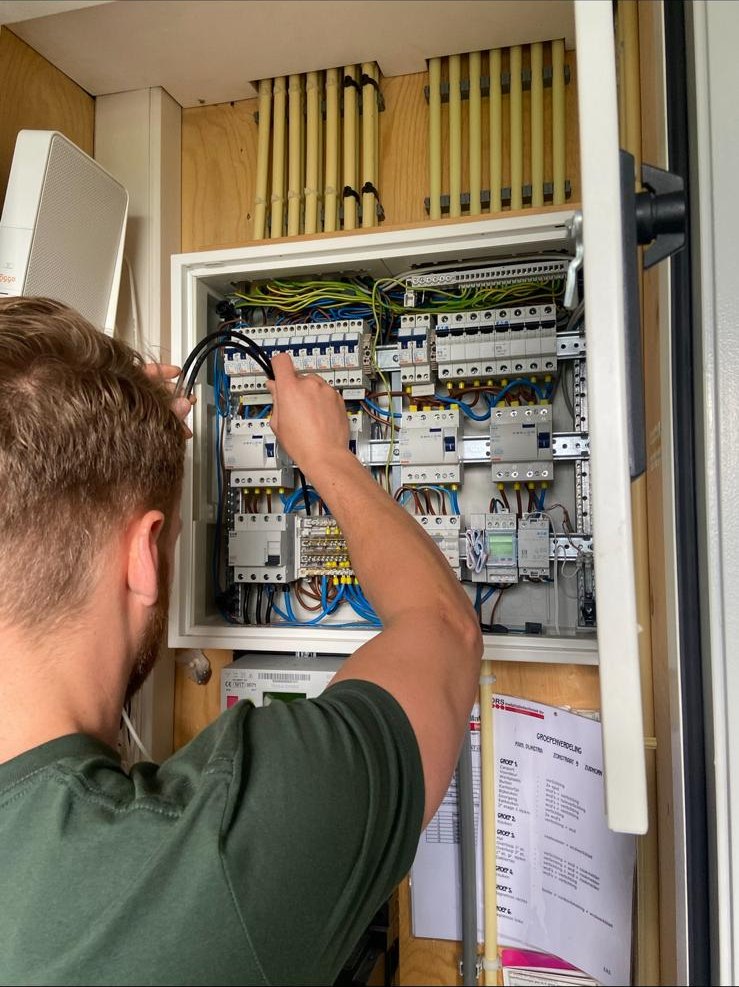
What does electrical rewiring involve?
An electrical renovation is not an afternoon job. It is a project that needs careful planning, especially when combined with a renovation. These are the components:
Fuse box replacement
The fuse box is the heart of your electrical installation. A modern consumer unit has dedicated circuits for heavy appliances (hob, dryer, EV charger), RCDs per circuit and room for future expansion. A standard replacement (8-12 circuits) starts from € 1,200 including labour and materials. If you need additional circuits for an EV charger or heat pump, expect a starting price from € 1,800. This work typically takes one working day.
Rewiring
If the cabling in your home is outdated – cloth, rubber or undersized gauge – it needs replacing. This is the most invasive component, as cables run through walls, floors and ceilings. A full rewire (all cabling throughout the home) starts from € 5,000, depending on the size of the home and the number of connection points.
This is exactly the right moment to be smart about it. If you are already renovating,bathroom, kitchen, floors coming up – the walls and floors are already open. The additional cost of including the electrics is far lower than doing it as a separate project.
NEN 1010 inspection
NEN 1010 is the Dutch standard for low-voltage installations in homes. After an electrical renovation, the installation is inspected against this standard. This is not only legally required, but also mandatory for your building insurance. Moreover, buyers increasingly ask for an electrical inspection report when purchasing a home. A certified installation improves saleability and prevents negotiation points.
RCDs and surge protection
Modern consumer units are fitted with RCDs (30 mA) per circuit or circuit group. Increasingly, surge protection is also installed to protect your equipment against spikes in the grid – a growing risk as the electrical grid faces increasing demand.
Future-proofing your home
Electrical rewiring is not just about safety. It is about readiness. The energy transition is coming and your home needs to be prepared.
From gas to induction
Switching from a gas hob to an induction hob requires a heavy-duty dedicated socket on a separate circuit of at least 16 amps, sometimes 32 amps for larger models. Your existing kitchen circuit is almost certainly not rated for this.
EV charger
An 11 kW home charger requires a three-phase connection and a dedicated 16 amp circuit per phase. Many older Groningen homes still have a single-phase connection, which limits charging to 3.7 kW. For most situations this is sufficient for daily use, but if you want faster charging, a grid upgrade through the network operator is needed.
Heat pump
A hybrid or fully electric heat pump requires its own circuit and sometimes a three-phase connection. Your fuse box needs to have capacity for this. If you rewire now, you can plan ahead – even if the heat pump is two years away.
Solar panels and home battery
Solar panels and home batteries require a dedicated circuit and often a smart meter. By running the right cables and circuits during the electrical renovation, you save yourself a second intervention later.
What does electrical rewiring cost? Guide prices
| Work | Starting price (incl. labour) |
|---|---|
| Fuse box replacement (8-12 circuits) | from € 1,200 |
| Fuse box with extra circuits (EV charger/heat pump) | from € 1,800 |
| Full rewire (all cabling throughout the home) | from € 5,000 |
| Heavy-duty socket for induction hob | from € 350 |
| Additional circuit | from € 250 per circuit |
| NEN 1010 inspection | from € 250 |
Combination tip: having the electrics done during a bathroom or kitchen renovation? Then you share the cost of demolition and finishing with the other project. In practice this saves 15 to 25% on the total cost of the electrical work.
Want to know what it costs in your situation? Get in touch for a no-obligation assessment – you will hear back within 24 hours.
Why choose a contractor who also does electrics?
Most electricians in Groningen only do electrics. They replace your fuse box, pull a cable and leave. But what about the tiles that need replacing, the holes in walls that need filling, or the floor that needs repairing? Then you need a second contractor. And a third for the tiling.
VerbouwGroep Noord is certified for electrical work (NEN 1010, STEK, CO-keur) and is also a general contractor. That means we handle the entire chain: from opening the wall to pulling the cable to plastering and finishing. One party, one schedule, no holes in your wall that nobody feels responsible for.
And that is precisely why it makes sense to include the electrics in a renovation. The bathroom is being stripped anyway? Then the wiring in that wall gets done at the same time. The kitchen is being renewed? Then we handle the heavy-duty socket and fuse box upgrade in the same pass. No extra demolition, no extra repair costs.
Frequently asked questions
How long does it take to rewire a home?
A fuse box replacement takes one working day. A full rewire with new cabling takes 3 to 5 working days. When combined with a renovation, the work runs alongside the overall schedule.
Do I need to be home during the work?
Yes, you need to be present or reachable. The power is temporarily shut off during the work. We always coordinate this with you in advance.
Can I get a subsidy for electrical rewiring?
There is no direct subsidy for electrical installation work itself. However, if you combine the electrical work with sustainability measures – such as a heat pump (ISDE subsidy) or insulation (Nij Begun programme, measure 29) – you can save significantly. VerbouwGroep Noord is happy to combine these projects.
How do I know if my home has a single-phase or three-phase connection?
Check your fuse box. With a single-phase connection you will see one main switch or one set of fuses. With three-phase you will see three. Not sure? We assess it free of charge during a no-obligation consultation.
Is it dangerous to postpone rewiring?
That depends on the condition of your installation. Outdated wiring and missing RCDs pose a real fire risk and risk of electrocution. When in doubt, a NEN 1010 inspection is the quickest way to know where you stand.
Can I have the electrical work done in phases?
Yes. For example, the fuse box and most critical circuits first, then the wiring in the rest of the home later. We advise you on the smartest sequence based on your situation and budget.

Ready to sort out your electrics?
Get in touch with Niels for a no-obligation consultation. He will assess your current installation, advise on what is needed and give you an honest price indication. You will hear back within 24 hours.